
The Century-Legacy of the Girls of Great Britain and Ireland Tiara
The British Royal Collection houses countless iconic jewelry masterpieces that bridge historical legacy and exquisite craftsmanship, among which Girls of Great Britain and Ireland Tiara stands out as one of the most recognizable and frequently worn heirlooms in modern royal history. Unlike overly grand coronation tiaras reserved only for supreme state ceremonies, this delicate and versatile diamond headpiece has accompanied British royal queens for over 130 years, gracing official portraits, banknotes, coinage, and numerous public engagements. Its enduring popularity stems from its unique historical origin, flexible wearable structure, refined diamond layout, and timeless classic design that never falls out of fashion.
Crafted in 1893 by the renowned British royal jeweler Garrard & Co in collaboration with E. Wolff & Co, this legendary tiara was originally a collective wedding gift organized by a women’s committee led by Lady Eva Greville for Princess Victoria Mary of Teck, who later became Queen Mary, on her marriage to the Duke of York, the future King George V. Funded through public donations from women across Britain and Ireland, the tiara carried sincere national blessings rather than exclusive royal private collection attributes, making it a special symbolic piece with profound civilian and national significance. The original design featured elegant scroll and festoon motifs embellished with fourteen large natural drop pearls on the upper edge, paired with dense diamond decorations at the base, adopting the popular delicate royal jewelry aesthetic of the late Victorian era.
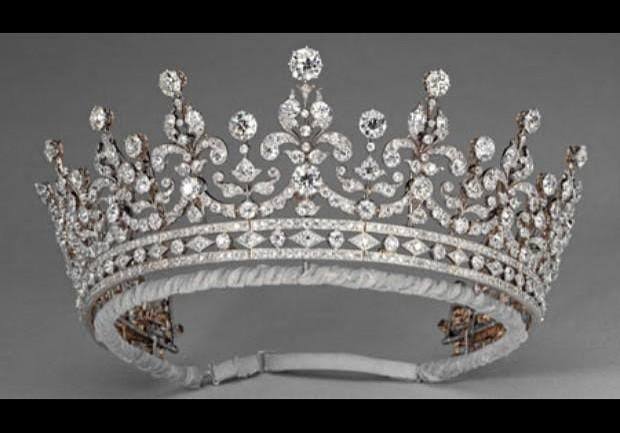
To adapt to evolving royal aesthetic trends and improve overall brilliance, Queen Mary redesigned the tiara in 1914, removing all the original top pearls and replacing them with additional brilliant-cut diamonds. This renovation streamlined the tiara’s silhouette, creating an all-diamond luminous effect that enhanced its modern and luxurious texture. Structurally innovative for its era, the tiara is equipped with dual detachable frames, allowing it to be worn as a standard ceremonial tiara, a smaller coronet, or fully disassembled and transformed into a diamond necklace. This multi-functional design perfectly reflects the practical and inheritable philosophy of classic royal jewelry, maximizing the utilization value of precious gemstones and high-end metal materials.
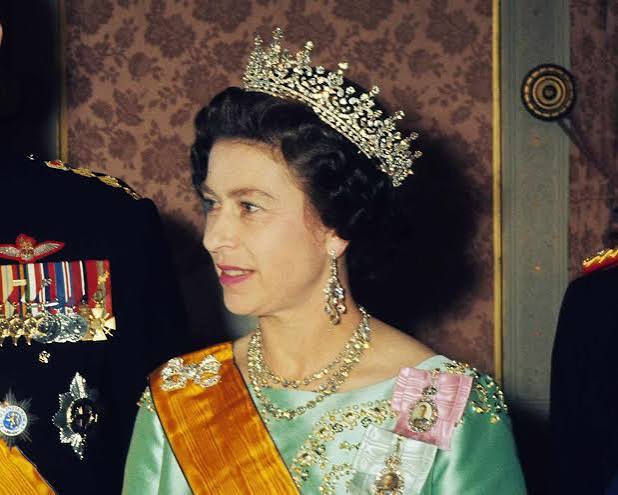
What makes this tiara visually stunning and structurally exquisite is its meticulous surface decoration featuring pave set diamonds, a sophisticated inlay technique widely favored by high-end jewelers in the 19th and early 20th centuries. Different from conventional single large stone inlay, pave setting arranges numerous small brilliant-cut diamonds closely and uniformly on the metal base, covering the entire surface with zero exposed gaps. This craftsmanship creates a continuous, shimmering diamond glow from every angle, eliminating visual dullness and endowing the tiara with a soft, radiant halo. The dense diamond paving echoes the tiara’s flowing scroll lines, balancing delicate elegance and regal magnificence, which explains why it remained Queen Elizabeth II’s favorite daily ceremonial tiara throughout her 70-year reign.
As vintage royal jewelry aesthetics regain global popularity, modern luxury jewelry markets are pursuing high-quality restoration and personalized innovation of classic heirloom works. In this context, professional custom 18k gold jewelry manufacturer has become the core force inheriting and revitalizing royal jewelry craftsmanship. Traditional royal tiaras mostly adopted silver or pure gold bases to highlight diamond clarity, while modern customized works upgrade the base material to premium 18K gold, which features higher hardness, better oxidation resistance, and more stable luster. This material optimization ensures long-term wear durability while retaining the classic texture of antique royal jewelry.
Professional custom manufacturers conduct in-depth research on the structural proportion, diamond distribution, and craft details of the Girls of Great Britain and Ireland Tiara. Through precise 3D scanning modeling, manual stone screening, and refined pave setting restoration, they accurately reproduce the tiara’s iconic scroll contours and full-diamond luminous effect. Meanwhile, modern craftsmen make humanized adjustments based on contemporary wearing scenarios, optimizing the radian and weight of the base frame to solve the heaviness problem of traditional antique tiaras. In addition to full-scale restoration, manufacturers also launch derivative customized works, including matching necklaces, brooches, and earrings, allowing ordinary jewelry enthusiasts to appreciate the charm of British royal craftsmanship.
For more than a century, the Girls of Great Britain and Ireland Tiara has witnessed the inheritance of four generations of the British royal family, evolving from a wedding blessing gift to a national symbolic jewelry. Its perfect combination of classic pave diamond craftsmanship, flexible multi-purpose structure, and profound historical background has set a high standard for vintage royal jewelry. With the support of professional 18K gold customized manufacturing technology, this century-old royal classic is no longer limited to palace collections. It continues to spread the timeless aesthetic of British royal jewelry, realizing the perfect inheritance of traditional craftsmanship and modern innovative design in the contemporary luxury jewelry industry.